
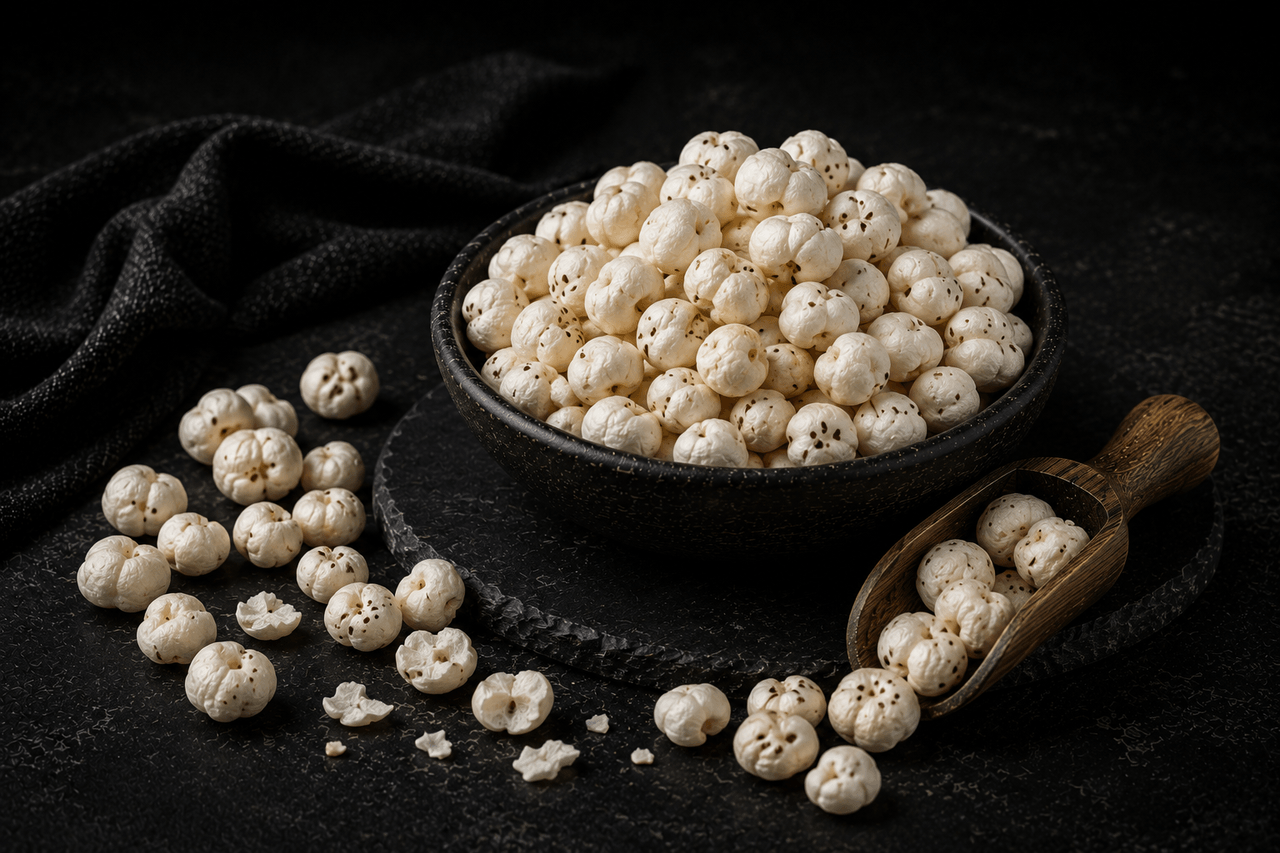
Makhana, also sold as fox nut or phool makhana, is the popped seed of the water lily Euryale ferox. Demand abroad has grown with the snack and health-food category, and since May 2025 India's tariff recognises it with its own lines. Here are the questions importers ask us most.
What is makhana and where does it come from?
The seeds grow in ponds and wetlands, are harvested, dried, roasted and popped into the white, light kernels sold as makhana. Bihar, and the Mithila region in particular, supplies most of India's crop, and Mithila Makhana carries a Geographical Indication tag. Because the supply chain is long and seasonal, grade and moisture vary more than buyers expect.
What is the HS code for makhana?
Since 1 May 2025 India's customs tariff carries three dedicated lines under heading 2008: 2008 19 21 for popped makhana, 2008 19 22 for makhana flour and powder, and 2008 19 29 for other forms. Only the first six digits (2008 19) are common to all countries. Your own customs authority adds its national digits, so confirm the full code with your broker before the first shipment. You can look the codes up in our HS code finder.
How is makhana graded?
By size. We list it as Suta 1 (the largest and the premium grade), Suta 2 (medium) and Suta 3 (small), plus a broken grade for food processors and a roasted or flavoured grade for retail. Larger kernels sell at a premium because more of the crop is smaller, so ask which grade a quote refers to and how the size is measured.
What quality checks should I ask for?
Moisture below 7%, foreign matter below 0.05%, popping ratio, colour uniformity, and a microbial and heavy-metal panel per batch. Moisture matters most. Popped makhana is light and porous and it takes up moisture from the air, which is why the packing below is not optional. Ask for a Certificate of Analysis for each batch, and for the batch number to appear on the carton.
How is it packed, and what are the minimums?
Bulk lots go in 5 kg or 10 kg vacuum-sealed cartons. Retail lots come in 100 g, 200 g and 500 g pouches, and private-label printing is supported. The minimum is 500 kg per SKU for retail packs and 3 MT per SKU for bulk, with a lead time of 12 to 20 days from purchase order. We load from Kolkata or Nhava Sheva (JNPT), and the full spec sheet is on the makhana product page.
Which documents come with a shipment?
The commercial invoice, packing list, Bill of Lading, certificate of origin, a phytosanitary certificate and the FSSAI health certificate, with the Certificate of Analysis for the batch. Some destinations add their own food-safety filing, which the importer or its customs broker makes. We explain what each certificate proves in phytosanitary certificate and certificate of origin from India.
What moves the price?
The size grade, the popping yield of the lot, the moisture, the packing format and the Incoterm. Seed prices swing with the harvest, so any fixed number goes stale. We quote against the current market: send the grade, pack size and destination port and you get a written quotation within 48 hours.
Tell us the grade, pack format and destination port and we will send a quotation and a sample plan.
— Nitik · Darsavio EXIM