
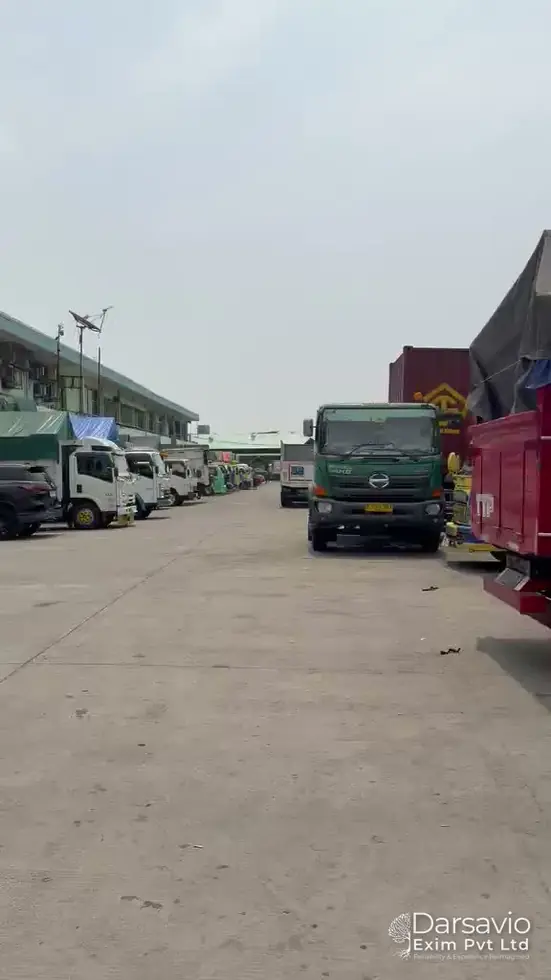
From 4 to 7 October 2026 we were in Jakarta, the founder and one team member. We checked our own rice container as it was offloaded in a Jakarta rice market, met two more rice importers and exchanged rice samples. It was a working trip, not a trade fair. Here is what we learned, in the order of how much it mattered, followed by the Indonesian import rules we could check and the ones we could not.

Do Indonesian rice importers ask about halal before price?
In our meetings, yes. Halal came up before the price did. Importers wanted to know whether the rice, and how it is handled, would stand up to halal documentation before they asked for a quotation. If you plan to sell rice in Indonesia, have your halal position clear before you travel.
The legal background explains why. Indonesia's halal law (Law 33/2014) makes halal certification mandatory for products sold in the country, and the deadline for imported food and beverage products was set for 17 October 2026 (one source gives 18 October), with the halal agency BPJPH saying it would enforce it. A foreign halal certificate can be registered with BPJPH, as described by the US Foreign Agricultural Service. What we could not confirm is how the rule applies to plain milled rice, as opposed to processed food. Ask your buyer, and check with BPJPH, before you rely on any reading of it.
Can you meet an Indonesian importer without an appointment?
No appointment, no meeting. Walk-ins get excuses, and in one case a walk-in was turned away at the door. The work happens before you arrive: qualify the buyer, verify that the company exists and imports what you sell, and inform them who you are and what you are bringing. Our own first step for any buyer is the same ten-minute check we ask buyers to run on us, set out in how to verify an Indian exporter.
How should you hand over a business card in Jakarta?
With respect: two hands, or at least the right hand. It is a courtesy, not a trick, and it costs nothing. A card handed over with one hand while looking at a phone tells the other side how you will treat their order.
How do you find out who imports what?
Read the product labels in the stores. The labels on the bags and cartons on the shelves name the importer, so a walk through a market shows you who buys which kind of rice and from which origin. That is how you build a map of the buyers before you ask for a single meeting. We are not naming any shop or importer here, and you should treat what you read the same way: as a lead to qualify, not a contact to cold-call.
How is rice import into Indonesia controlled?
This is the part to check against official text. The Agricultural and Processed Food Products Export Development Authority (APEDA) issued an advisory on 4 December 2025, based on information from the Embassy of India in Jakarta. Its main points: Indonesia has no ban on rice imports, but rice is under strict quota-based control under Presidential Regulation No. 59 of 2020, with quotas set by the National Food Agency (Bapanas) according to supply and demand, and only importers holding that recommendation can apply for an import approval. There are two kinds of import permit, one for industrial importers such as rice-flour mills and one for merchant importers (household and retail). The advisory says Indonesia continues to need specialty rice that cannot be grown at home, naming basmati, parboiled and Sona Masoori among them, and tells exporters to watch policy changes and consult the Embassy in Jakarta or APEDA before deciding on a shipment. The full text is on the APEDA site.
What we could not confirm
- Whether plain milled rice is treated as a halal-covered product under the October 2026 rule, and which halal certificates BPJPH will accept for rice.
- The text and effect of Indonesian Trade Ministry Regulation 47/2025. Press reports say it restricts several rice types under HS 1006, basmati among them, from 1 January 2026. We could not verify this against the regulation itself, so treat it as unconfirmed.
- Current quota volumes and which importers hold a Bapanas recommendation. This changes, and only the importer and Bapanas can tell you.
- Plant-quarantine requirements for rice at Indonesian entry points. We found no official, rice-specific statement.
What to do before you travel
- Confirm that your buyer holds the import permit for the kind of rice you sell.
- Ask what halal documentation they expect, and from whom.
- Fix the appointment in writing, with the buyer's own confirmation.
- Bring rice samples packed and labelled the way the shipment will be.
- Check the latest APEDA and Embassy guidance the week before you go.

For the rice we supply and the corridor itself, see our India to Indonesia export page and the rice export catalogue in Bahasa Indonesia. If you buy rice in Indonesia and want a quotation, send us an enquiry.
— Darsavio EXIM