
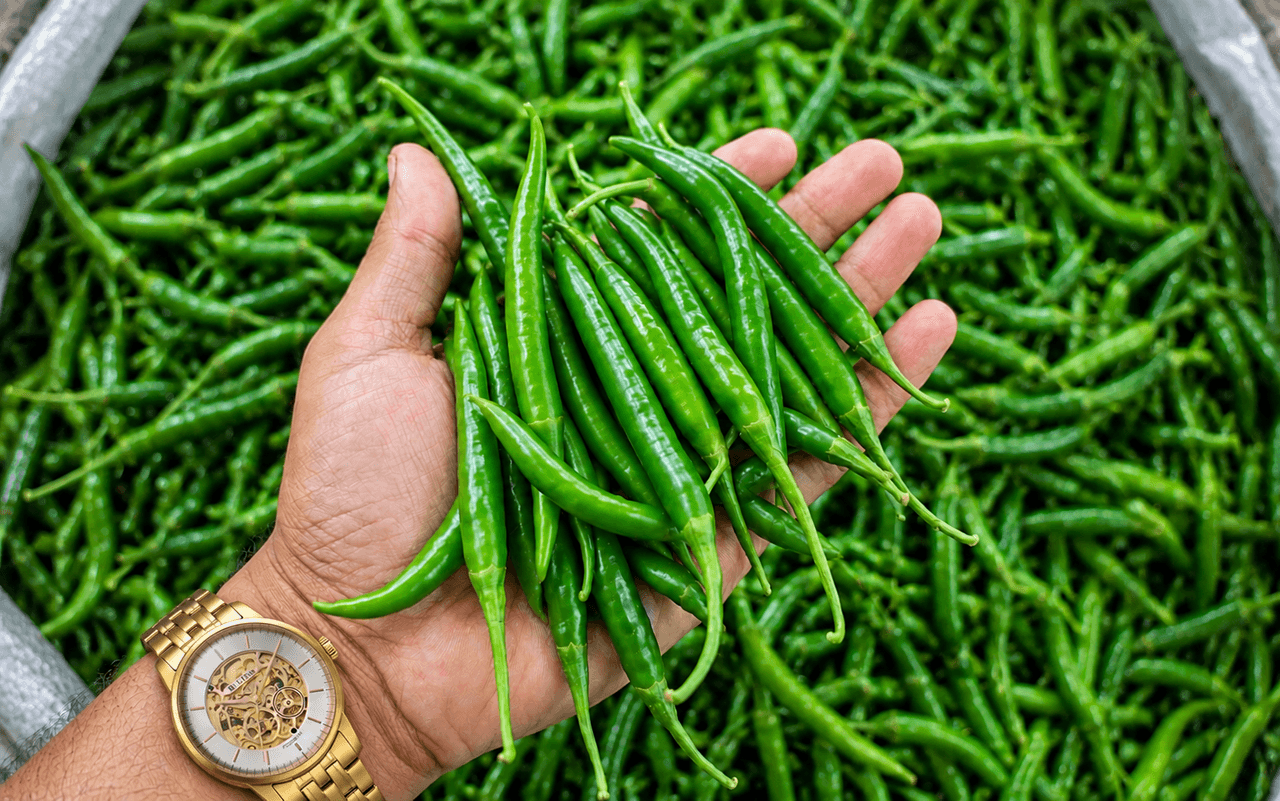
A buyer asks for "green chilli, export grade" often enough that the request stops meaning anything specific. There are dozens of green chilli cultivars grown across India; only a handful hold up to a two- or three-week sea or air journey without going soft, wrinkled, or moldy at the stem. G4 is one of the ones that does, and it's worth knowing why before you commit a container to it.
What G4 actually is
G4, also called Guntur-4, belongs to the Sannam S4 cultivar family, grown concentrated in Guntur, Khammam, and Warangal districts of Andhra Pradesh and Telangana. Andhra Pradesh alone produces over 1.1 million tonnes of chilli a year, dry and green combined, which is the scale that makes consistent export-volume sourcing possible in the first place.
The trait that actually matters for a buyer: G4 has a thicker skin than most green chilli sold domestically in India. Thin-skinned varieties bruise and soften fast, which is fine for a local market three hours from the farm but a real problem on a 15-day sea transit. Thick skin buys shelf life, reported at roughly 12–15 days pre-cooled and held at 4–6°C, which is the difference between a container that arrives sellable and one that arrives as compost.
Grade and pungency, in numbers
Export-grade G4 runs 6–10cm pods, dark green, blemish-free, 10–12 fruits per bunch, and falls under India's AGMARK statutory grading for chillies. Pungency is commonly reported at 25,000–40,000 Scoville Heat Units, worth stating plainly because a few seed-marketing sites publish a figure north of 130,000 SHU for this cultivar family that doesn't match Spice Board or agricultural-station sourcing anywhere else we checked. If a supplier quotes you a number that high for fresh G4, ask where it came from.
The certificate UAE buyers miss
Every fresh chilli shipment out of India needs the same baseline: Phytosanitary Certificate from DPPQS, APEDA registration with HortiNet traceability, Certificate of Origin, and an FSSAI health certificate. Chilli also sits on APEDA's shortlist of five vegetables (alongside drumstick, brinjal, bitter gourd, and curry leaf) that get a mandatory pesticide-residue protocol before export: a minimum 1kg sample drawn from at least 30 farms per consignment, tested at a NABL-recognised lab, results in 36 hours.
The one that catches first-time UAE buyers off guard is destination-specific: MOCCAE, the UAE's federal plant-protection authority, requires an additional declaration on the phytosanitary certificate for Capsicum (chilli and pepper generally), confirming the consignment is free of Tuta absoluta (tomato leafminer) at every life stage. It doesn't apply to most of the rest of this catalog. It applies specifically to chilli, and a certificate missing that line is a real reason for a Dubai Municipality inspector to hold a container at the port.
Where it clears easily, and where it needs a phone call first
UAE and Singapore are the straightforward lanes. UAE needs the Tuta absoluta line added; Singapore has no chilli-specific treatment requirement at all once your buyer holds a standing SFA import licence. The UK has no advance import-permit system, but runs the strictest MRL (pesticide residue limit) regime of the group, so the upstream growing practice matters more there than the paperwork does.
USA, Indonesia, and Thailand are where we'd stop short of a blanket "yes." All three gate fresh produce admissibility behind a commodity-by-origin-country approval list, and none of those lists are fully public: APHIS's ACIR database for the US, an annual RIPH import-quota list for Indonesia, a Pest Risk Assessment for Thailand. Indonesia's own "Reference Price" regulation does specifically track red chilli varieties, which is a reasonable signal chilli is an actively monitored category there, but that's a different thing from confirmed market access. For any of these three, we run a live check with a customs broker before quoting a chilli order, rather than assuming clearance from a generic produce list.
What we actually put in a G4 shipment
Phytosanitary Certificate, APEDA/HortiNet registration, Certificate of Origin, FSSAI health certificate, and the pesticide-residue lab report. UAE orders also carry the Tuta absoluta declaration. Packed 5kg or 10kg in ventilated corrugated board (16 vent holes, 350–450 Kgf compression) or 5kg EPS thermocol, moved through Hyderabad or Chennai by air. Full spec sheet is on the G4 green chilli product page.
— Nitik · Darsavio EXIM